


ALL FAQS
The Basque Energy Transition and Climate Change Act provides a stable regulatory framework with new opportunities and implies new requirements. Ihobe has compiled the main implications of the Act 1/2024 with the focus on the municipalities.
 Municipalities' frequently asked questions on the Basque Law on Energy Transition and Climate Change
The earth’s atmosphere is warming, with serious consequences for our environment and societies. To limit the rise in global temperature to 1.5°C above pre-industrial times and reduce the negative effects of climate change, the planet needs to rapidly reduce its emissions of climate-warming greenhouse gases (GHGs) in order to reach a level of net zero CO2 emissions by 2050.
In the light of scientific evidence, it is clear that further measures on both climate mitigation and adaptation are urgently needed, given the increasingly evident, severe negative effects of climate change and public demands for more decisive action.
Europe has set ambitious climate standards and has started to transform the economy in line with climate targets. In line with Europe, the Basque Country has adopted Law 1/2024 to set a target of net zero greenhouse gas emissions by 2050, and will make the efforts required to achieve this climate neutrality by 2045.
The main objectives set out in the Law are:
- To achieve climate neutrality in the Basque Country by 2050 at the latest, making the efforts required to reach this goal by 2045;
- To reduce GHG emissions by 45% by 2030 compared to 2005;
- To save at least 12% in final energy consumption by 2030 compared to 2021;
- To achieve a share of renewable energies in final energy consumption of at least 32% by 2030;
- To increase the resilience of the region to climate change.
Law 4/2019 on energy sustainability is complementary. Therefore, its obligations remain in force and the bodies included in this text are adapted to the new legal framework. This means that the sustainability commissions that appear in the previous law are transformed into energy transition and climate change commissions, while the energy sustainability plans will be transformed into climate and energy plans. They are both therefore complementary legal texts and the objectives set at the local level are maintained. The Basque Government department responsible for energy and climate change shall draw up an instruction manual, within a maximum period of one year from the approval of this Law, setting out the instruments, methodologies and tools that Basque Country municipalities may use to draw up their own Climate and Energy Plans.
In addition, this Law 1/2024 enables the sectoral obligations established in Law 4/2019 of 21 February on Energy Sustainability in the Basque Country to be revised upwards through planning or regulatory instruments that are approved.
The law defines a series of new bodies to improve energy-climate governance. Leaving aside the provisions to set up the Scientific Committee on Energy Transition and Climate Change, the bodies with the greatest impact on local action will be the Basque Office for Energy Transition and Climate Change and the Citizen Assembly for Energy Transition and Climate Change. In addition, the scope of existing commissions such as the Environmental Advisory Council and the Basque Council for Local Policies is expanded.
The Basque Office for Energy Transition and Climate Change will be the technical reference for Basque public administrations on decarbonisation, and climate change adaptation and resilience. The Office is responsible for monitoring the objectives pursued by the law and controlling compliance with regulations, gas inventories, energy transition indicators, updating climate scenarios, vulnerability assessment, information, training and communication channels, dissemination activities, management of the Basque observation system, and supporting the Scientific Committee and the Citizen Assembly. The Basque Government shall approve the operating regulations of the Basque Office for Energy Transition and Climate Change within a maximum period of one year from the approval of this Law.
In addition, the Citizen Assembly on Energy Transition and Climate Change is set up with the aim of promoting citizen participation.
To adopt the Basque Social Pact on Energy Transition and Climate Change, the Basque Government will design and promote a shared process through local and regional decision-making processes which will involve various political, social and economic agents. This process will be designed within six months following the entry into force of the law.
The historical territories and municipalities with more than 5,000 inhabitants must approve climate and energy plans, within the framework of their competences. These plans shall incorporate the provisions of Law 4/2019 of 21 February on Energy Sustainability in the Basque Autonomous Community, and integrate the climate variable from the perspective of climate change mitigation and adaptation, in line with the purpose and content of the Law on Energy Transition and Climate Change.
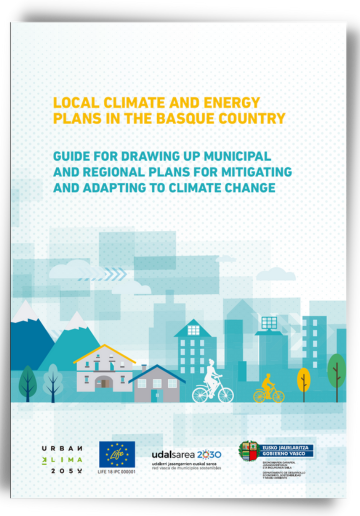
In the case of town councils in municipalities with more than 5,000 inhabitants, they must prepare and approve a report on the degree of compliance with their plans every two years. These plans shall contain: an analysis and assessment of greenhouse gas emissions; identify and characterise vulnerable elements, objectives, and strategies for climate change mitigation and adaptation; describe possible suitable modifications to urban planning and municipal ordinances; and detail awareness-raising and training actions.
When a mobility plan is mandatory according to Law 11/2023 on sustainable mobility in the Basque Country, this plan must be coordinated with local plans.
Municipalities with a population of less than 5,000 inhabitants may draw up climate and energy plans on an individual or county basis.
Article 27 of the Law states that Basque public administrations must promote and facilitate the development of renewable energy projects, thereby encouraging citizen participation in this type of activity. In particular, local citizen participation will be encouraged in projects promoted by citizen energy communities, renewable energy communities or other participatory schemes.
In addition, society as a whole will be encouraged to play an active role in the energy transition, both through self-consumption, energy communities, and through participation in renewable energy and/or storage facilities.
A right to the surface or space on publicly owned property may be constituted in favour of renewable energy communities and legally constituted citizen energy communities. This right would be used to develop renewable energy generation or energy storage projects or other initiatives that pursue the object described in the definition of these communities.
Solar photovoltaic and wind renewable energy projects that individually or jointly have a total power per site exceeding 5 MW (which are not promoted by energy communities and have not initiated the procedure to obtain the administrative authorisation for their development) must offer at least 20% of the total project power to the public and to industry and commerce, prioritising the municipality where the renewable energy plant is located or the neighbouring municipalities or districts, regardless of who promoted the project in the first place.
Measures to facilitate the production of renewable energies in situ or in the vicinity of buildings will also be established through regulations.
Finally, a regulation shall set out the deadline and conditions for Basque public administrations progressively replace equipment that uses fossil fuels and is located in public buildings with equipment that runs on renewable energy sources.
Spatial and urban planning and management must minimise greenhouse gas emissions and integrate climate risk and vulnerability analysis and climate change adaptation.
This planning must promote an urban structure that is resilient to climate change, compact, and with mixed uses. New models of climate change adaptation shall be developed by promoting the permeabilisation of land and urban green spaces, incorporating criteria to avoid heat waves. They shall also include rainwater regulation, reuse and filtration systems, urban green infrastructure, and measures to minimise the risk of flooding and promote more efficient and adaptive buildings.
Furthermore, in the urban planning field, green infrastructure and nature-based solutions will be promoted and the use of artificial land will be limited. Land occupation shall be rationalised, degraded spaces shall be used, and the sustainable use of energy and water, as well as the management of waste, soil and biodiversity shall be promoted.
Urban regeneration interventions are also established as an opportunity to incorporate adaptation measures by implementing bioclimatic principles in urban and architectural design. .jpg)

The Law includes a number of actions aimed at increasing the resilience of the territory, both on land and in the continental, marine and coastal aquatic environment. The objective of the standard is to increase the resilience of the Basque territory to climate change. It therefore foresees actions to:
- Identify and protect critical and sensitive infrastructures, analysing their climate risk.
- Increase the resilience of the inland, marine and coastal aquatic environment.
- Promote responsible use of water resources and drought and flood management, taking climate risks into account.
- Protect natural heritage, ensure ecosystem diversity and resilience, and increase ecological connectivity.
- Identify the most vulnerable areas in the agroforestry, livestock and fisheries sectors and promote their resilience.
- Improve understanding of the effects of climate change on the health system and develop preventive measures.
- Adapt emergency, civil protection, and security systems to climate change events.
Some of these measures have a particular impact at the municipal level, as municipal emergency and public health plans, among others, will be revised.
.jpg)
Article 57 of the Law states that contracting bodies of the Basque public administrations must include the obligation to provide the carbon footprint of products, services and supplies in the administrative clauses and specific technical specifications of their contracts.
This shall become mandatory within the deadline to be set out in the regulations approving the organisation and operation of the Register. Bidding companies may justify the carbon footprint of products, services and supplies by accrediting its registration in the Basque Register of Energy Transition and Climate Change Initiatives.
This accreditation shall assist contracting bodies of the Basque public administrations that include the obligation to provide the carbon footprint of products, services and supplies in the administrative clauses and specific technical specifications of their contracts.
Ihobe, the Basque Government’s public environmental management company, will provide Basque companies with a simplified tool that will make it easier to calculate this carbon footprint. 
The draft General Budget Law of the Basque Country must incorporate the energy and climate perspective, earmarking 2.5% of the budgets for climate action measures.
Other Basque public administrations should promote the integration of the energy and climate perspective into their public budgets, particularly in their design phase. The budgets shall identify actions that have a positive impact on energy transition and climate change, for both mitigation and adaptation, in accordance with the guidelines to be established.
Therefore, Councils shall promote the integration of the energy and climate perspective in their public budgets, particularly in the design phase, identifying actions that have a positive impact on energy transition and climate change, for both mitigation and adaptation, in accordance with the guidelines to be established.
The Basque public administrations shall coordinate an assessment of certain taxes on actions that increase vulnerability or increase greenhouse gas emissions. They shall also provide tax incentives for actions that favour the mitigation, reduction and absorption of emissions, and climate change adaptation, when technically and economically possible.
Among other objectives, taxation on energy transition and climate change should aim to promote: renewable energies; the decentralisation of networks and energy self-consumption; energy-efficient buildings and housing; sustainable mobility; circular economy models for decarbonisation; sustainable forestry and agricultural management; the prevention of waste generation; and the recovery of energy and materials from waste.
On the other hand, the fee to set up renewable energy facilities on undeveloped land in the Basque Country is a direct, regular tax of an extra-fiscal, real, compensatory nature, through which the Basque Government taxes renewable energy facilities on undeveloped land
The fee affects both renewable energy facilities set up in the Basque Country prior to the entry into force of the Law, and those set up once the Law has come into force, regardless of whether or not they are in operation. This Basque Government fee will be used to finance the development of environmental conservation, replacement and restoration actions.
The revenue from the fee will also be used for actions to encourage and promote the rational use of energy, aimed at increasing efficiency in the use of renewable energy resources; adapting the territory to the effects of climate change; conserving natural heritage; and the recreational and educational use of natural resources. All plants with a capacity of less than 5 MW and those used for self-consumption of any size are exempt from the fee.
This fee will enter into force on 1 January 2025.