



12
nov
2022
Amaia Barredo: The COPs are essential but need to evolve towards a model where the decisions are not just made by the States
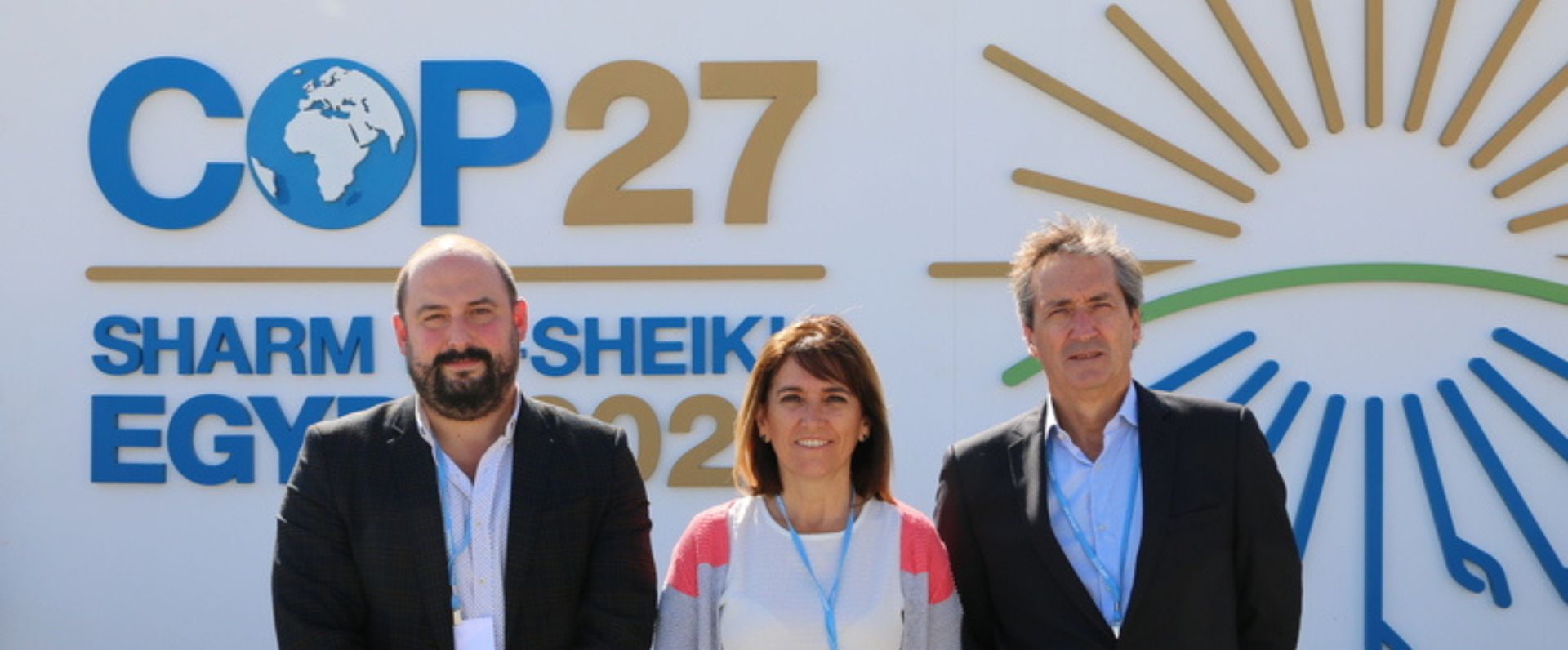
.jpg) The Basque Government's Deputy Minister for Environmental Sustainability, Amaia Barredo, considers that climate summits should evolve so that "decisions are not just made by the States". She champions the incorporation of countries that must be heard due to their vulnerability to climate impacts, even though they do not currently have decision-making political clout.
The Basque Government's Deputy Minister for Environmental Sustainability, Amaia Barredo, considers that climate summits should evolve so that "decisions are not just made by the States". She champions the incorporation of countries that must be heard due to their vulnerability to climate impacts, even though they do not currently have decision-making political clout. The Basque delegation at the Egypt Climate Summit believes the Basque Country is well positioned as an advanced region in adaptation, even though it needs to keep up the pace and uphold commitments in that regard
The Basque Country considers that Climate Summits are more necessary than ever as they are an opportunity to review the progress regarding climate undertaking and for accountability to the international community regarding specific actions. The official discussions do not currently take into account the views or opinions of the regions, despite their governments along with the local authorities being the institutions tasked with implementing 70% of the mitigation measures and 90% of the adaptation measures to advance in the undertakings of the Paris Agreements.The Egyptian presidency of COP27 had precisely opted for multilateralism, that together with the increased ambition and action in fighting climate change is restoring confidence and making this Climate Summit the "implementation COP" in order to re-establish the great consensus at the centre of the Paris Agreement. The Climate Summit has highlighted the need for a financing model where the most polluting countries economically contribute to reduce the existing gap with developing countries, which are being more intensely affected by the consequences of climate change in the form of extreme droughts, lack of drinking water and flooding.
Specific measures
The Basque Country has spearheaded the voice of the regions with the presentation of the "Declaration of the Regions for COP27", signed by 45 regional governments calling for greater support, decision-making and financing
Adaptation has been one of the cornerstones of COP27 and is a policy area where the Basque Country has specific measures and results that have been set out in the Regions Adapt Progress Report 2021-2022, which was presented on 10 November during the event organised by Regions4 and Under2 Coalition. The document, which includes 322 climate adaptation actions by 32 regions from 16 countries, highlights the contribution of Life Urban Klima, the Basque Country's largest climate action project for the coming years. It positions the Basque Country as an advanced region with a high degree of adaptation implementation. Deputy Minister Amaia Barredo mentioned the preparation of the risk assessment of the rising sea level for the coastal area inhabited by 55% of the Basque Country's population, and the setting up of video-surveillance and weather forecasting systems to prevent risks and integrate new information in the risk prevention plans.The Basque Country is firmly committed to fulfilling the international emissions undertakings. The Greenhouse Gas Inventory, which is voluntary for regions and prepared by Ihobe, the Basque Government's environmental management agency, confirms that the emissions are falling in the territory, as they are lower than the pathway level set to achieve the targets for 2030. Furthermore, the Basque Country has been selected to take part in the States and Regions Remote Sensing (STARRS) pilot scheme. Coordinated by The Climate Group and the Climate TRACE emissions inventory platforms, the scheme will provide accurate data on the emissions of the states and regions using satellite information.
Transformative projects in 2023
The Basque Government is driving transformative projects to mainstream adaptation, by following international scientific standards and adapting them to Basque reality. The Basque Country has annually invested around 200 million in projects to drive a new ecological and economic transition to neutrality and resilience. The Basque Country's 2023 draft budget envisages the deployment of clean energies to accelerate the energy transition process, with a comprehensive strategy focused on industry, the public administrations and the general public. The Deputy Minister for Environmental Sustainability has explained in Egypt that the Basque Government is planning to promote energy projects (photovoltaic, wine and marine power; hydrogen, biomethanisation and biomass) to the tune of 56.1 million. The Basque Government plans to earmark 114.5 million to bolster public funding to foster renewable energy, electrification of mobility and energy efficiency, and 85 million to drive projects for industry to reduce emissions and to become more competitive.
Source: Ihobe