


- Circular economy
- Ecodesign
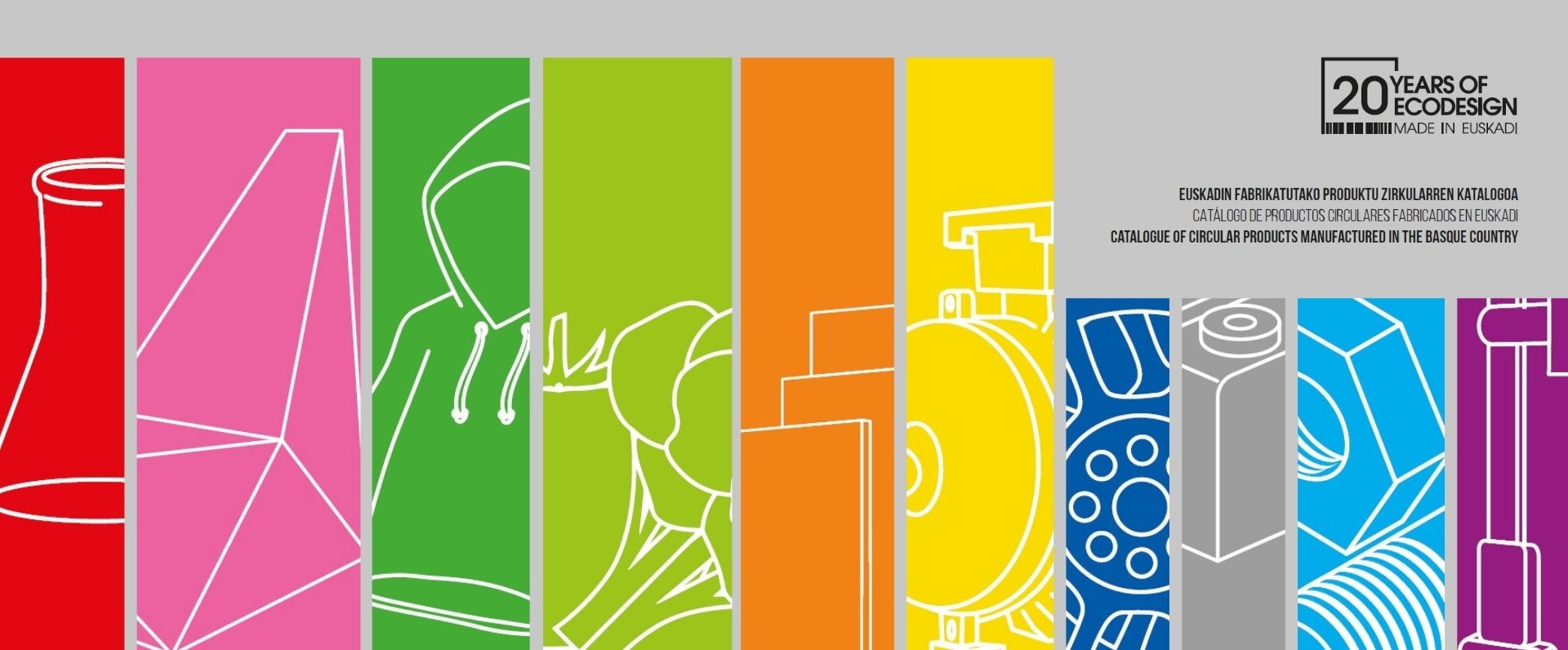
Ihobe launches a catalogue of circular products manufactured in the Basque Country
More than 100 of the products in the catalogue were exhibited at the Basque Ecodesign Meeting 2020 conference
More than 100 of the products manufactured by Basque companies and featured in the catalogue were on show at an exhibition held in the framework of the Basque Ecodesign Meeting-BEM 2020 conference held in Bilbao in February 2020, attended by representatives of Basque companies and experts in ecodesign.The catalogue, the first of its kind in the Spanish State, compiles individual data sheets containing the main characteristics and aspects of each circular product, dividing them into ten sectors, namely the chemical industry, the metal sector, furniture, automotive, food, production and consumption, machinery, transport, electric-electronic, and the construction materials sector.
Ecodesign in ten Basque sectors
The Basque chemical industry is responsible for more than 4,000 jobs and focuses, primarily, on creating innovative products that are marketed internationally. European environmental regulations on chemicals are a driving force for ecodesign in Basque industry that integrates renewable and recycled substances, minimises packaging and even proposes changing business models.
The metal sector accounts for 34% of jobs in Basque industry. This sector consumes all metal alloys, which are known as critical materials because of their high environmental footprint and global scarcity. Therefore, alloy and product ecodesign, efficient production processes and advanced scrap management are pivotal challenges to address and will impact the sustainability of other industries, such as the automotive, renewable or machinery sectors.
The transport equipment sector, excluding automotive, accounts for 9% of the gross industrial value added in the Basque Country, while raw materials account for 59% of costs in this sector, including rail, maritime and aeronautical. The ecodesign of sustainable and lighter materials, lengthening of the life of products and components, as well as maximising the use of infrastructures and means of transport, are trends that are being anticipated by the industry.
The furniture and habitat sector employs more than 5,000 people in the region, who design and manufacture high-end, high-quality products. Increasingly stringent government procurement environmental requirements across Europe and growing public awareness are driving the Basque sector to introduce sustainable and recyclable materials, as well as to create modular and remanufacture products.
With 300 companies and 41,000 jobs, the Basque automotive component sector is one of the most competitive and innovative. In the Basque Country, raw materials account for 72% of costs in this sector. Efficient production processes, lightweighting, closure of material cycles, giving components a second life, coupled with new ownership models are key circular economy challenges to be addressed in this sector.
The industrial sectors that manufacture products targeted at the consumer sector are more focused on textiles and paper goods if we exclude food, furniture and construction products. The European Commission has launched a Sustainable Textiles Strategy which will substantially change the playing field, as was the case with plastics.
The machinery and equipment sector accounts for 11% of the gross industrial value added in the Basque Country. A design with a life-cycle approach that integrates 4.0, eco-efficient technologies, advanced maintenance, retrofitting, remanufacturing, and the product-as-a-service business model are all circular economy challenges to be addressed in the sector.
The food and beverages marketing and distribution activities in the Basque Country generate more than 50,000 jobs, and the agro-food sector consumes about 6 million tonnes of food per year. The European Commission is committed to bio-economics and the environmental footprints of food products, creating opportunities in the sector such as process eco-efficiency, by-product reuse and new sustainable packaging.
The electric and electronic sector contributes 15% of the gross industrial value added in the Basque Country and the raw materials consumed by this sector represent 57% of these costs in the Basque Country. Renewables and electric-electronic equipment are already subject to energy efficiency requirements that are addressed by design, and the European Commission is developing new standards to boost durability with new designs, 4.0 maintenance, remanufacturing, advanced recycling and modifications to business models.
Finally, the construction materials sector, with more than 100 manufacturers in the Basque Country, responds with a paradigm shift based on productivity and sustainability to overcome the stagnation of the past. On the one hand, construction is evolving toward a model that allows it to grow based on the optimisation and standardisation of increasingly industrialised processes, and, on the other, it is advocating ecodesign that ensures that products of increasing value can be recycled for global marketing.
More than two decades leading the environmental revolution in ecodesign
More than 20 years have passed since the first ecodesign projects were implemented in the Basque Country. During this period, many Basque companies have incorporated environmental criteria starting with the design and development phase of their products, and the region has become a benchmark in Southern Europe, particularly in the industrial field. The Basque Country also leads the Spanish State in the production of eco-designed products and services: more than half of the companies certified in ecodesign (54%) are Basque companies. Even so, there is room for improvement.
The Basque Government's diagnosis of the circular economy in the region concludes that further implementation of the circular economy in the Basque industry would reduce the consumption of raw materials by 6% with economic savings of up to 2bn. Overall, ecodesign could mean an additional 57bn in revenue for the industry by 2030 and household savings of 500 per year, according to the European Commission.
The catalogue of circular products manufactured in the Basque Country, 20 years of ecodesign. Made in Euskadi is published by Ihobe the Publicly-Owned Environmental Management Company of the Basque Government and SPRI, in collaboration of the Habic, Eraikune, ACICAE, Siderex, MLC ITS Euskadi clusters, the Energy Cluster Association, the Basque Food Cluster, the Basque Maritime Forum, Kimika, Mafex the Spanish Railway Association, AFM and BaskEgur.
The digital version of the catalogue will be a living publication and will be constantly updated with new circular products. To do this, Basque companies can submit their products for inclusion by completing the following form.
Source: Ihobe