


- Circular economy
Ihobe shares circular economy expertise at a top-tier international panel organised by the Ibero-American General Secretariat
Ihobe, the Environmental Management Agency attached to the Basque Governments Ministry of Economic Development, Sustainability and the Environment, presented its circular economy projects, including the current Basque circular economy strategy and the future waste plan, during the international panel. The session was an opportunity to showcase international, local and business circular economy initiatives in the Ibero-American region.
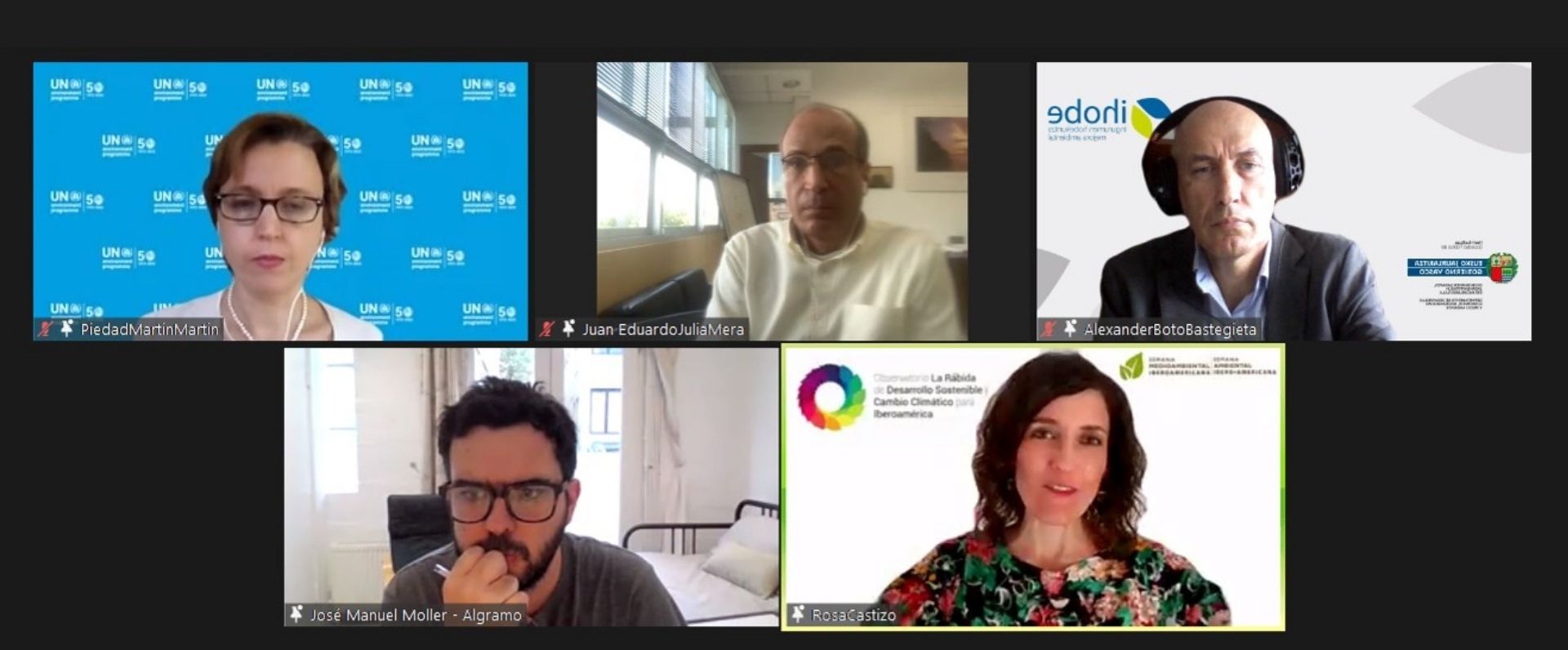
Alexander Boto Bastegieta, Ihobes General Manager, took part together with Piedad Martín, the UNEP Regional Director for Latin America and the Caribbean; Milagros De Champs, Deputy Minister of International Cooperation of the Ministry of the Environment and Natural Resources Dominica Republic; Luisa Santiago, Latin America Director of the Ellen Macarthur Foundation; and José Manuel Moller, Algramo CEO. The session, as part of the Ibero-American Environmental Week, was the opportunity to showcase international, local and business circular economy initiatives in the region.
The Ibero-American General Secretariat (SEGIB), the panel organiser, is an international support agency for the 22 countries making up the Ibero-American community: the 19 Spanish- and Portuguese-speaking countries of Latin America and those from the Iberian Peninsula (Spain, Portugal and Andorra). It supports the organisation of the Ibero-American Summit, by implementing its mandates and driving Ibero-American Cooperation in the fields of education, social cohesion and culture. It is the only official space for convergence, work, monitoring and agreements of the Ibero-American region that brings together countries on both sides of the Atlantic.
The Basque Country as an advanced region in the circular economy
For years now, the Basque Country has been successfully working on the circular economy, a new way of using resources and, therefore, of relating to the environment. So far this century, the Basque economy has grown by 26%, while material consumption has fallen by 25% and the volume of municipal waste ending up in landfill is down by 56%. The Basque economy is also managing to reduce consumption of material and waste generation by driving circular economy measures.
The Circular Economy Strategy of the Basque Country 2030, presented by Ihobes General Manager during the session, is part of this scenario. Its aim is to drive the transition towards a more resource-efficient economy by means of innovation oriented towards a new production and consumption model, with the emphasis always on public-private partnership effectively involving citizens, companies and the Administration.
During his turn, Alexander Boto Boto also spoke about some key points of the Basque Waste Prevention and Management Plan 2030, a waste planning instrument in the sphere of the Autonomous Community of the Basque Country on which the Basque Government is working. It will replace the previous plan, in force up until 2020, and will allow advances to be made in the prevention, management and treatment of hazardous and non-hazardous waste, and municipal waste in our territory.
The preparation of this Plan is dictated by Europes strong impetus to developing the Circular Economy, with which it is closely linked, and the global threat of climate change from the perspective of the waste sector as a contributor to CO2 emissions.
The Ihobe General Manager also pointed out that the Basque Country had recently unveiled the Basque Green Deal, the new roadmap for a sustainable, fair and green economic development. Industry and technology are the roadmaps main drivers of transformation and it will have key legislative instruments, such as the Energy Transition and Climate Change Act or the Natural Heritage Act.
Source: Ihobe