


29
sep
2023
Tapia reminds the Committee of Regions4 that Europe needs to be competitive to address climate challenges ambitiously
Tapia called for a more recognised and active role of the regions in leading sustainable development, and stressed the need for the development model to heed a principle of justice to leave nobody behind.
The climate energy transition has to be demanding and ambitious in the achievement of the targets set, without ignoring the industrial, technological and economic development of Europe overall, and of each and every one of the European Regions.
Accordingly, she reiterated her support of the decision adopted by the Council of European Industry Ministers that same week, as a competitive Europe is needed for innovation to contribute to the achievement of the climate goals.
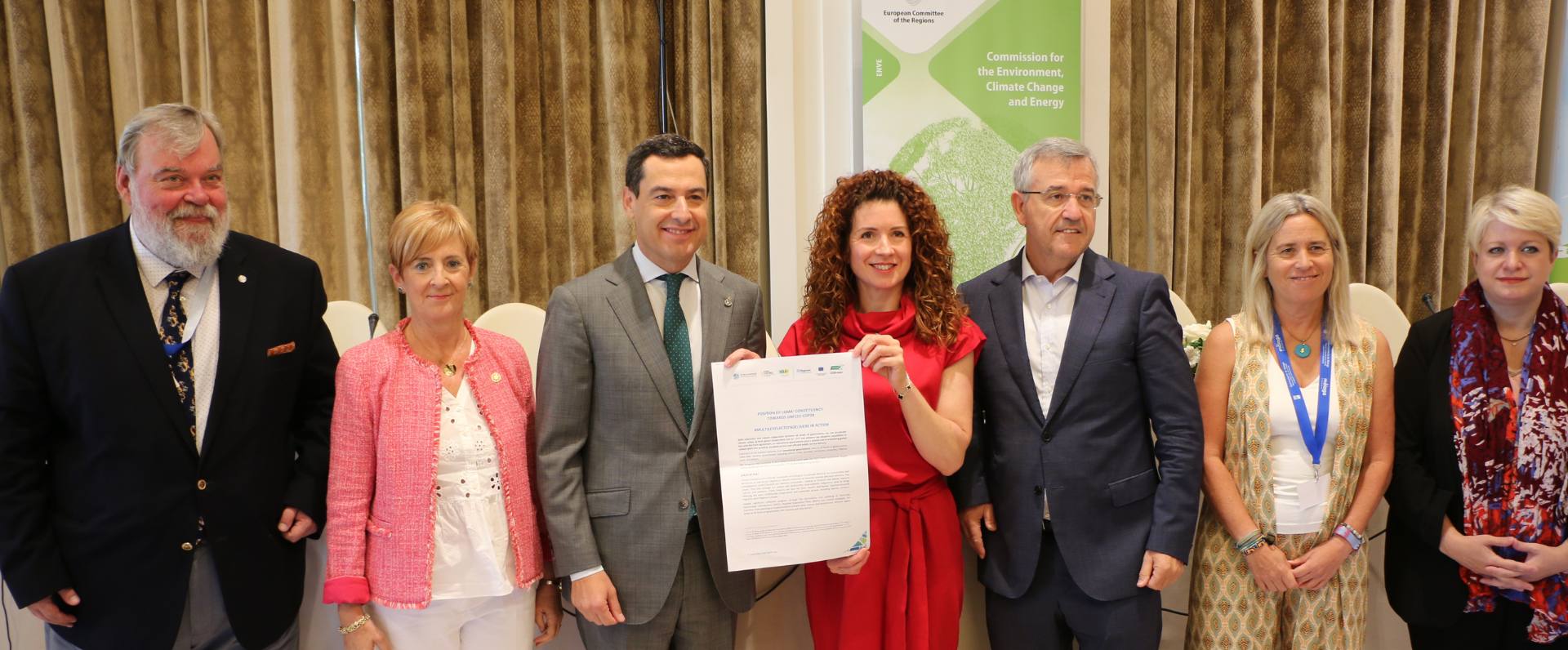
The Commission for the Environment, Climate Change and Energy (ENVE) of the European Committee of the Regions (COR) has met in Malaga; around 100 members, including the Basque Country, discussed different key climate and environmental issues of the current EU mandate. Opinions on governance of the European Green Deal and the Hydrogen Bank were approved. Key issues regarding COP28 were analysed; special mention should be made of the agreed declaration for the Dubai event Towards a Local Governments and Municipal Authorities (LGMA) position for the UNFCCC COP28 to which the Regions4 international network and the Basque Country, as hosts, expressed their support.
Official discussions do not currently take into account the views or opinions of the regions, despite their governments, along with the local authorities, being the institutions tasked with implementing 70% of the mitigation measures and 90% of the adaptation measures to advance in the undertakings of the Paris Agreements.
Therefore, the submitted manifesto calls for an evolution of global governance and a new multilateral consensus. In addition to the state, that would involve citizens, local, regional and national authorities, civil society and the economic sectors, in close cooperation with the supranational institutions. The future of global governance is based on cooperation, decentralisation and inclusive multilateralism, and that "will be the only way to achieve that just transition".
These demands are also reflected in the recent Sixth IPCC Report and in the summary of the Global Stocktake of the United Nations Framework Convention on Climate Change (UNFCCC). Both documents stress that the governments of the states are lagging behind on fulfilling their commitments, and likewise highlight the greater climate ambition of the regions.
Therefore, stakeholders such as the Network of Regional Governments for Sustainable Development - Regions4, currently chaired by the Basque Country, should play a fundamental role in this new multilateralism.
The session in which Minister Arantxa Tapia took part, as the Regions4 Chair, was led by Kata Tüttö, Deputy Mayor of Budapest and Chair of the ENVE. Lia Montalti, representative of the Under2 Coalition network of Emilia-Romaña (Italy) participated as well; these are the 2 main international networks in which the Basque Country plays a key role.
The climate energy transition has to be demanding and ambitious in the achievement of the targets set, without ignoring the industrial, technological and economic development of Europe overall, and of each and every one of the European Regions.
Accordingly, she reiterated her support of the decision adopted by the Council of European Industry Ministers that same week, as a competitive Europe is needed for innovation to contribute to the achievement of the climate goals.
Meeting of the Commission for the Environment of the Committee of the Regions
The Commission for the Environment, Climate Change and Energy (ENVE) of the European Committee of the Regions (COR) has met in Malaga; around 100 members, including the Basque Country, discussed different key climate and environmental issues of the current EU mandate. Opinions on governance of the European Green Deal and the Hydrogen Bank were approved. Key issues regarding COP28 were analysed; special mention should be made of the agreed declaration for the Dubai event Towards a Local Governments and Municipal Authorities (LGMA) position for the UNFCCC COP28 to which the Regions4 international network and the Basque Country, as hosts, expressed their support.
Official discussions do not currently take into account the views or opinions of the regions, despite their governments, along with the local authorities, being the institutions tasked with implementing 70% of the mitigation measures and 90% of the adaptation measures to advance in the undertakings of the Paris Agreements.
Therefore, the submitted manifesto calls for an evolution of global governance and a new multilateral consensus. In addition to the state, that would involve citizens, local, regional and national authorities, civil society and the economic sectors, in close cooperation with the supranational institutions. The future of global governance is based on cooperation, decentralisation and inclusive multilateralism, and that "will be the only way to achieve that just transition".
These demands are also reflected in the recent Sixth IPCC Report and in the summary of the Global Stocktake of the United Nations Framework Convention on Climate Change (UNFCCC). Both documents stress that the governments of the states are lagging behind on fulfilling their commitments, and likewise highlight the greater climate ambition of the regions.
Therefore, stakeholders such as the Network of Regional Governments for Sustainable Development - Regions4, currently chaired by the Basque Country, should play a fundamental role in this new multilateralism.
The session in which Minister Arantxa Tapia took part, as the Regions4 Chair, was led by Kata Tüttö, Deputy Mayor of Budapest and Chair of the ENVE. Lia Montalti, representative of the Under2 Coalition network of Emilia-Romaña (Italy) participated as well; these are the 2 main international networks in which the Basque Country plays a key role.
Source: Ihobe