


20
mar
2023
The Life Urban Klima 2050 project shows the progress of its climate actions in Gipuzkoa to the European Commission monitors
Monitors from NEEMO, the European Commission's technical support service for the LIFE programme, will visit the Basque Country on March 20 and 21 to see some of the actions being carried out in the region first hand
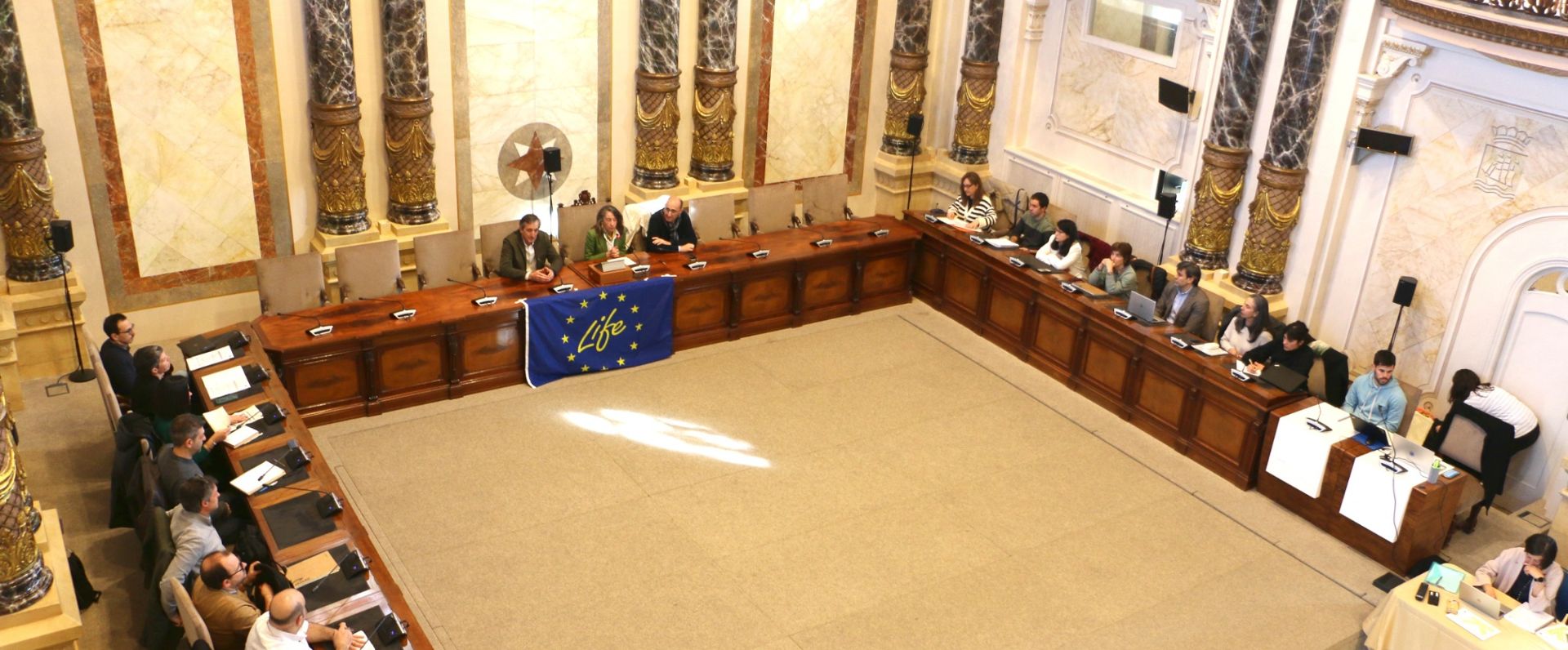
The heads of the monitoring team met the 20 partner entities involved in the project led by Ihobe, the Basque Government's public environmental management company, in Donostia/San Sebastian . The monitors also had the opportunity to learn about some of the actions that are being carried out in Donostia and Zarautz.The visit began on Monday, March 20 with an information session at the Donostia/San Sebastian City Hall. Marisol Garmendia, Councillor for Ecology, welcomed the attendees and underlined the "collective effort" of the LIFE IP Urban Klima 2050 project involving nearly 20 partners. It is transforming the Basque territory thanks to 40 climate change mitigation and adaptation actions. San Sebastián City Council is taking part as an institution that is perfectly in line with its goals, namely, to reduce greenhouse gas emissions, increase the share of renewables, achieve greenhouse gas neutral and progress towards a more climate resilient territory. We are very pleased with the way we are implementing the measures envisaged in our city, with specific actions that are already underway in different areas.
Meanwhile, Adolfo Uriarte, Director of Natural Heritage and Climate Change of the Basque Government, outlined the work carried out by the Basque Government in the field of climate action. "The Basque Country has a clear objective: to move towards a carbon neutral economy by 2050 and to become a region that is resilient to the negative impacts of climate change. And we are on the right track. Since 2005, the Basque Country has reduced its greenhouse gas emissions by 35%. And thanks to the Urban Klima 2050 project, among other actions, we are working hand in hand on solutions adapted to our region, particularly in coastal areas, river basins and urban areas. Urban Klima 2050 is a project with a holistic, country-wide vision, to build multi-level climate governance that will allow us to tackle the climate challenge in the best possible way, as a region that is prepared and capable".
During the session, representatives of the partners in the project presented the progress they have made over the past year. Advances such as the integration of climate change in territorial and urban planning, health policies or energy and water policies. Other actions presented have been the natural solutions that have as a scenario the three Basque capitals with pilot projects in Punta Zorroza (Bilbao), Anoeta (Donostia), or the old town of Vitoria-Gasteiz.
The urban-rural connection in different points of the three Historical Territories also includes actions such as the recovery of the natural space of Tonpoi, in the coastal area of Bermeo and which is in the second phase of intervention in the Arizatxu area; the promotion of ecological and local agriculture in the Aramangelu/Basaldea park in the surroundings of Vitoria-Gasteiz; or the creation of a green ring in the area of Debabarrena in Gipuzkoa. Riverside forests of the Natura 2000 network have also been reforested in Álava and natural solutions will be implemented in various rivers such as the Estepona in Bakio with the creation of an urban marsh and a floodable forest.
Visit to Ondarreta, the Sirena hostel, Errekatxulo and Zarautz
They will make a field visit to see the progress made at the Sirena hostel, Errekatxulo and Zarautz, together with the project's partner organisations
In the morning, the session ended with a virtual visit to the Soraluze plantation and the coastal videometry station located in Igeldo to obtain data from the Ondarreta and La Concha beach area and integrate them in the risk prevention plans.In the afternoon, the delegation traveled to different points of Donostia and Zarautz to see first hand the progress of the pilot projects being carried out in both municipalities. At the Albergue de la Sirena they saw the solar panels installed. Then, the delegation moved to the intervention area of the Errekatxulo river, where the regatta has been renaturalized and conditioned. Finally, they visited Zarautz to learn about the solutions proposed to reduce the impact of the combined effect of waves and tides on the seawall.
The second day was held Tuesday, March 21, with a technical session at Ihobe's headquarters in Bilbao.
Second visit by NEEMO to the Basque Country
This is the second visit by NEEMO monitors to the Basque Country after the one on November 25 and 26, 2021, which concluded with a very satisfactory assessment of the progress and management of the project. On that occasion, the meeting was held at Ekoetxea in Urdaibai, from where they visited the municipalities of Bermeo and Bakio to learn first-hand about the progress made on the pilot projects being carried out in both towns. They visited the Tonpoi area on the Bermeo coast, where the environmental and social recovery work has been carried out, through the creation of a peri-urban green infrastructure for public use, with sustainable criteria adapted to climate change. They did a tour of the area at risk of flooding in Bakio, where plans are underway to create a flooded riverside woodland and a flooded wetland.
About LIFE IP Urban Klima 2050
The LIFE IP Urban Klima 2050 project is the largest climate action project in the Basque Country until 2025, with twenty or so entities involved and a budget of 19.8 million euros, 51% of which is funded by the European Union
The largest climate action project in the Basque Country has a budget of 19.8 million euros and will transform the Basque region by coordinating a total of 40 climate change mitigation and adaptation actions between 2019 and 2025.Urban Klima 2050 is led by the public company Ihobe, part of the Basque Governments Ministry for Economic Development, Sustainability and the Environment, which works with around 20 entities, including two other areas of the Basque Government (the Ministry for Health and the Directorate of Ports and Maritime Affairs); the three provincial councils; the city councils of Bilbao, Vitoria-Gasteiz, Donostia/San Sebastián, Bakio, Bermeo, Gernika-Lumo and Zarautz; two Basque public companies (EVE and URA), as well as technology and research centres (AZTI, BC3, Neiker, Tecnalia and Tecnun) and the Naturklima foundation
Source: Ihobe