


- Economía circular
The European ICEBERG project faces its last year of activity with all case studies in progress
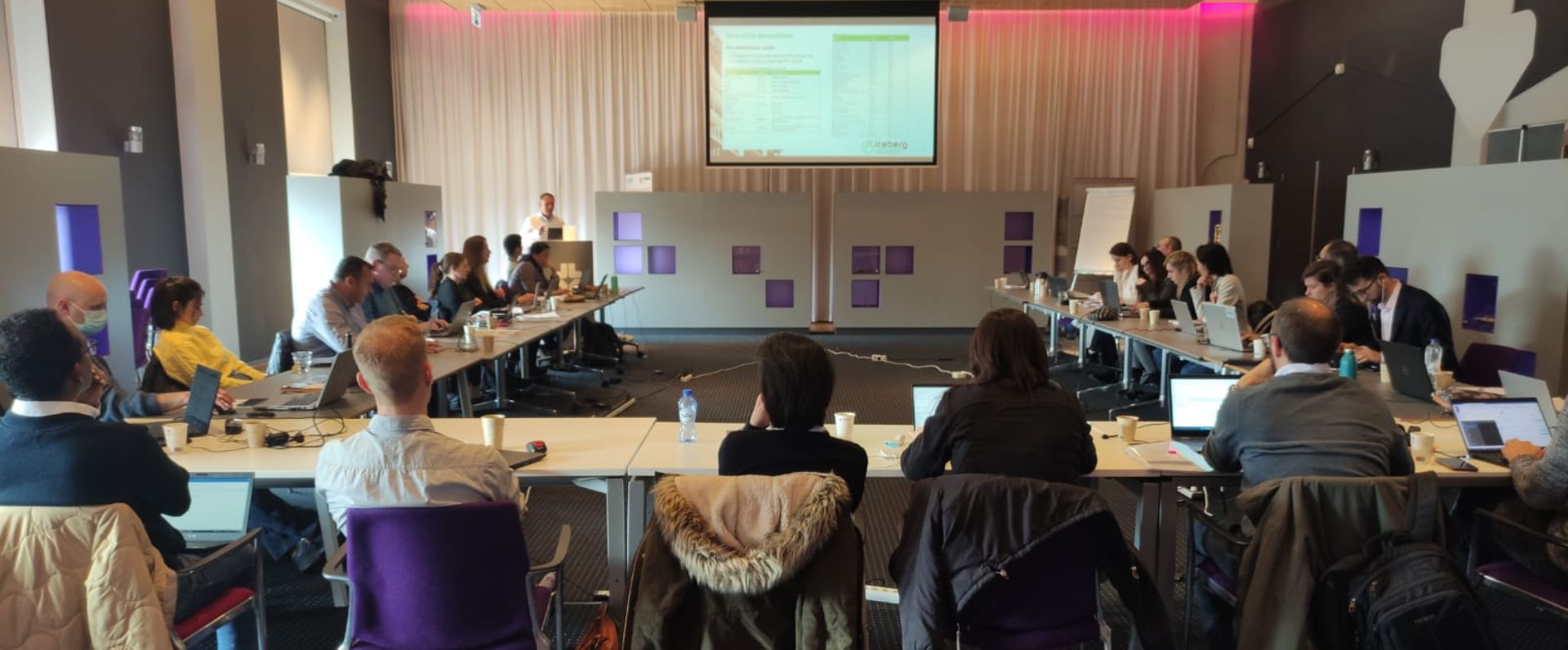
.jpg) The meeting also served to show the new EU scientific officer for the follow-up of the project, Laura Petrov, evidences of the progress achieved. In this sense, during the general assembly, one of the case studies coordinated by GBN Groep was visited, which is mainly being developed in the Netherlands, at the recycling facility of GBN in Hoorn, around the circularity of concrete. New technologies developed within the ICEBERG Project have allowed to implement a pilot experience that has managed to separate fine aggregates of cement paste from concrete. Thus, aggregates can be used again in new mortars, concretes, asphalt or unbound applications, and the cement part returns to the cement plant for the manufacture of clinker, a key material in the elaboration of the cement.
The meeting also served to show the new EU scientific officer for the follow-up of the project, Laura Petrov, evidences of the progress achieved. In this sense, during the general assembly, one of the case studies coordinated by GBN Groep was visited, which is mainly being developed in the Netherlands, at the recycling facility of GBN in Hoorn, around the circularity of concrete. New technologies developed within the ICEBERG Project have allowed to implement a pilot experience that has managed to separate fine aggregates of cement paste from concrete. Thus, aggregates can be used again in new mortars, concretes, asphalt or unbound applications, and the cement part returns to the cement plant for the manufacture of clinker, a key material in the elaboration of the cement.
Six Basque organizations are part of the project: the TECNALIA Research & Innovation Foundation -coordinator of the consortium-, the Public Environmental Management Company of the Basque Government-Ihobe, the Gaiker technology centre, and the companies Serikat, Lezama Demoliciones and Viuda de Sainz
The European project ICEBERG - acronym of Innovative Circular Economy Based solutions demonstrating the Efficient recovery of valuable material Resources from the Generation of representative End-of-Life building materials - is funded by the European Union within the Horizon 2020 Framework Programme for Research and Innovation (contract 869336), and suggests addressing the circularity of the most commonly used materials in construction, from the recovery and recycling of construction and demolition waste (CDW) to the development of more sustainable products.
The aim is to design, develop and validate innovative reuse systems and technologies, which allow to produce high value recovered materials low level impurities (less than 8%) and reliable. The industrial-scale validation will be performed through six case studies in different locations in Europe, thus covering the circularity of concrete, ceramics, wood, plaster, insulating foams and superinsulating materials. This is also intended to improve the reliability and acceptability of recycled materials from waste from the construction sector.
.jpg)
Perception study
In parallel to the fieldwork carried out in the six case studies, the ICEBERG Project has already generated nine scientific publications with a great communicative impact, the works for the new patents that will be generated are in progress and, in addition, a high degree of involvement has been achieved by the industrial sector in Europe.
At the same time, Ihobe-Public Environmental Management Company of the Basque Government has led a pilot study among the population of the Basque Country to find out the degree of acceptance of recycled products intended for construction.
The results of the surveys indicate that, although the population maintains a positive attitude towards the widespread use of secondary materials, this mere awareness may not be sufficient to achieve the objectives, which is the reason why other incentives are necessary to overcome certain barriers. Likewise, it is necessary to continue raising awareness about the huge impact of the construction sector and the benefits of circularity in this area.
It is expected that the study can be scaled up to the rest of the European countries participating in the ICEBERG project, which would provide situation data for the entire continent and would be useful for making better decisions on how to generate a true market for secondary materials in the construction sector.
At present, there are large differences in the circularity index between Member States, since the secondary use of materials differs from the EU average of 12.8%, from 1.3% in Romania to 30.9% in the Netherlands.
About ICEBERG
The project, which started in 2020 and which will last until 2024, has a budget of 15,667,498 euros, of which the European Union provides 12,997,935 euros through the Horizon 2020 Framework Program for Research and Innovation
The duration of the ICEBERG project will be four years and has a budget of 15,667,498 euros, of which the European Union provides 12,997,935 euros. In the first half of the project, tools and technologies have been developed to improve traceability, identification, separation, recycling and reuse of materials from construction and demolition waste. The second part of the project will be intended specifically to demonstrate these solutions in six case studies, analyzing their economic and environmental impact.
The Netherlands is focusing on the case study regarding circularity of concrete, Turkey on cement-derived products, Finland on recycling of construction wood, Belgium on carbonation to improve secondary materials and manufacture new products, the United Kingdom on plaster recycling, and France and Spain are addressing circularity of ceramic products.
Fuente: Ihobe