



- Sostenibilidad local
Udalsarea 2030 tackles the implications for local entities of Law 7/2022 on waste and contaminated soils
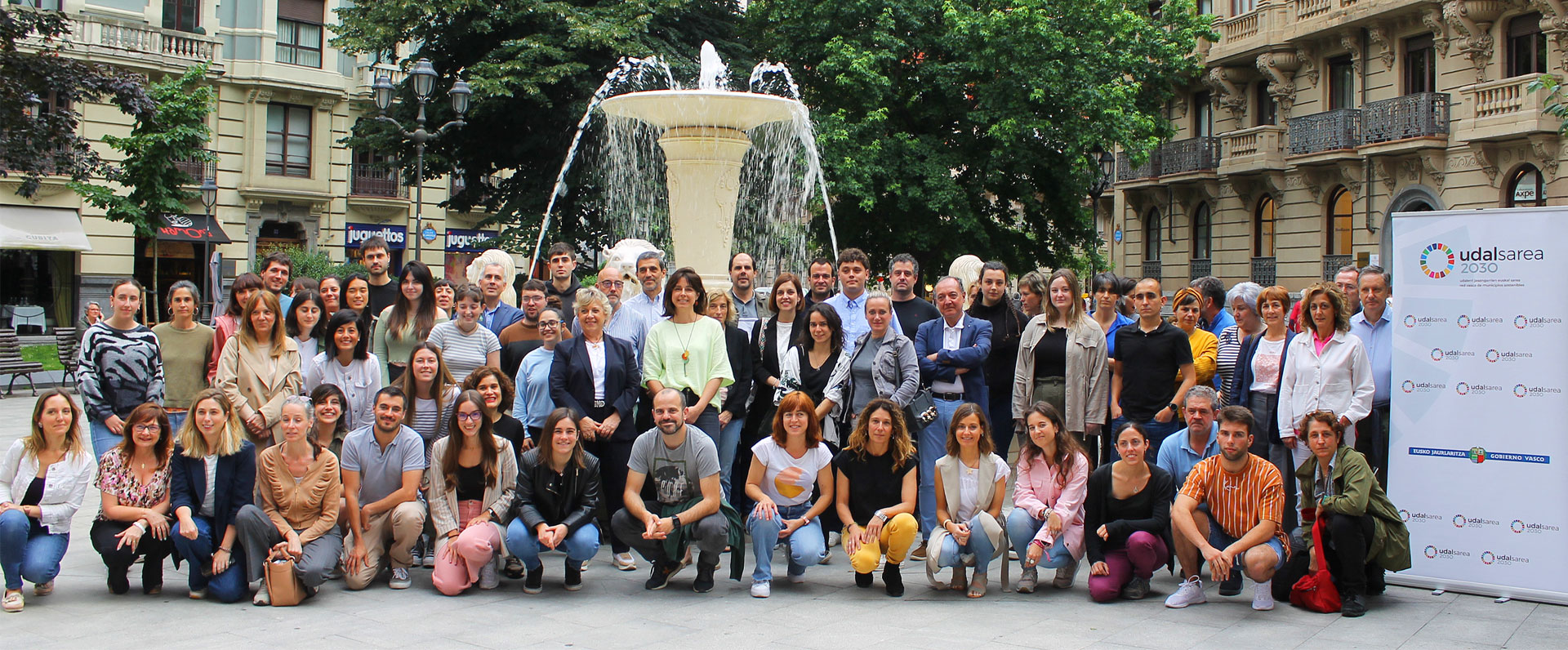
The 63rd Technical Committee for Udalsarea 2030, held in the auditorium of the Association of Basque Municipalities EUDEL, has reviewed the Networks activities over the last quarter and presented the upcoming lines of work.
María Mar Zabala Mardaras, Director General of Eudel, welcomed the participants and highlighted the importance of networking for Udalsarea 2030. Networks are where we exchange ideas, best practices and knowledge. In a country like ours, with small municipalities, networks are critical, she pointed out.
At the meeting, which brought together 70 people from 59 member organisations, the networks technical secretariat, through Agate Goyarrola (Ihobe), reported on the activities of the working groups on Land Protection, Green Public Procurement (GPP), Climate Action and Low Emission Zones (LEZ) and on the closure of the Eleventh Assessment and Monitoring Programme on Public Policies for Sustainable Development.
In relation to the eleventh programme, it was explained that 29 entities participated in the assessment process, 60 entities in GHG emissions indicators and calculations, 23 entities in the GPP Working Group, and 7 climate and energy plans were assessed.
Finally, the upcoming inclusion of a dashboard on the Udalsarea 2030 website was announced. This dashboard will include information on basic indicators of local bodies activities (members, 2030 Agenda Plan, Climate and Energy Plan or adherence to the Green Public Procurement Programme).
Virginia Andrés Aranberri, head of HAZIs Territorial Development Unit, presented the work undertaken by HAZI as a member of Udalsarea 2030. In her address, she referred to the recently approved Rural Development Act: The goal is to preserve rural areas, promote and diversify economic activities, improve the level of well-being of the rural Basque population, and reverse depopulation and the ageing of the rural environment as an essential factor for social and territorial cohesion in the Basque Country. The converging lines of work focus mainly on the standardisation and pooling of criteria in relation to protected environments and areas. In this sense, the participation of large municipalities with small populations and the collaboration with rural development agents will be key.
Malake Muñoz (Ihobe) and Álvaro Pérez Laborda (EVE) explained the strategy to boost local actions on climate and energy in the Basque Country. According to the Draft Law on Energy Transition and Climate Change (TECC), all local entities in the Autonomous Community of the Basque Country must take actions related to energy transition and mitigate and adapt to climate change. Municipalities with more than 5,000 inhabitants must adopt climate and energy plans that implement Law 4/2019.
The diagnosis presented at the technical committee on the situation of the 251 municipalities shows that 70% of them urgently need to act either due to high levels of risk and vulnerability to the impacts of climate change or because of the amount of GHG they emit.
The strategy sets 5 goals to boost local climate and energy initiatives in the Basque Country between 2023 and 2025: Increase the number of Basque municipalities that have a Local Climate and Energy Plan (PLCE); Ensure Basque municipalities move towards climate neutrality and territorial resilience; Boost the implementation of actions; Promote a climate governance model; and Promote citizen empowerment.
The Technical Committee also explained the details of the second call of the Lanbide Youth Employment for Climate Change and Energy Transition in Local Administrations programme, integrated within Erreminta-gida and promoted by EVE and Ihobe in collaboration with the Novia Salcedo Foundation.
EVE explained that the initiative is aimed at municipalities, associations of municipalities, local councils, local development agencies, provincial councils and entities dependent on local authorities and that this first career experience programme will facilitate the recruitment of up to 30 young people, experts in climate change and energy transition.
The programme seeks to offer local governments support in developing climate and energy plans tailored to their specific needs, enabling them to improve environmental sustainability in their spheres of responsibility through the funded recruitment of young people. On the other hand, thanks to this training programme, young talents incorporated in the local governments will receive training in energy transition and climate change.
The committee was informed of the 2023 local sustainable development aid programme, which is already in the pipeline and is expected to be published in the coming weeks. It was announced that the 7 lines of work from the previous year would be maintained: contaminated soils, climate change, natural heritage, circular economy, local eco-innovation, education for sustainability and Asteklima.
During the second session of the Technical Committee, after the break, a seminar was held on the implications for local entities of Law 7/2022 on waste and contaminated soils on the circular economy, in which José Antonio Armolea (Ihobe) and Ana Rebate (Ihobe) answered the queries of the attendees.
The Law on Waste and Contaminated Land for a Circular Economy aims to prevent and reduce the generation of waste and the adverse effects of waste generation and management, to reduce the overall impact of resource use and to improve the efficiency of such use to protect the environment and human health, and to effect the transition to a circular economy to ensure the efficient operation of the internal market and long-term competitiveness.
Among the obligations stipulated in the legislation with regard to the local responsibilities regarding waste management is the need to draw up waste management programmes for towns with more than 5,000 inhabitants; to include green procurement criteria; to include training and awareness-raising regarding contracts with waste collection and treatment companies; to assume subsidiary responsibility for the management of non-hazardous commercial waste in the event the producer fails to comply with waste management obligations; to separate and recycle bio-waste at source through domestic and community composting; to establish control mechanisms through the periodic characterisation and reduction of unwanted waste for each separate collection stream; to submit an annual report to the Autonomous Community on the management of waste under local jurisdiction; and to establish a tax to finance municipal waste collection and management.
The session ended with a question and answer session, which sparked great interest due to the difficulties and lack of clarity in the interpretation of some issues included in the regulations and, in particular, the issue of asbestos with regard to the obligation to draw up inventories of asbestos in each municipality by April 2023 and the corresponding plan to remove asbestos from public land by 2028 based on vulnerability criteria. The Basque Government, through Ihobe, the Department of Health, and the Department of Employment (Osalan), is working on a methodological guide to prepare these inventories.
Fuente: Ihobe