



2026ko azaroaren 24a
- Ekonomia zirkularra
- Ekoberrikuntza
- Ekodiseinua
Alexander Boto: The circular economy is competitiveness; it is economics
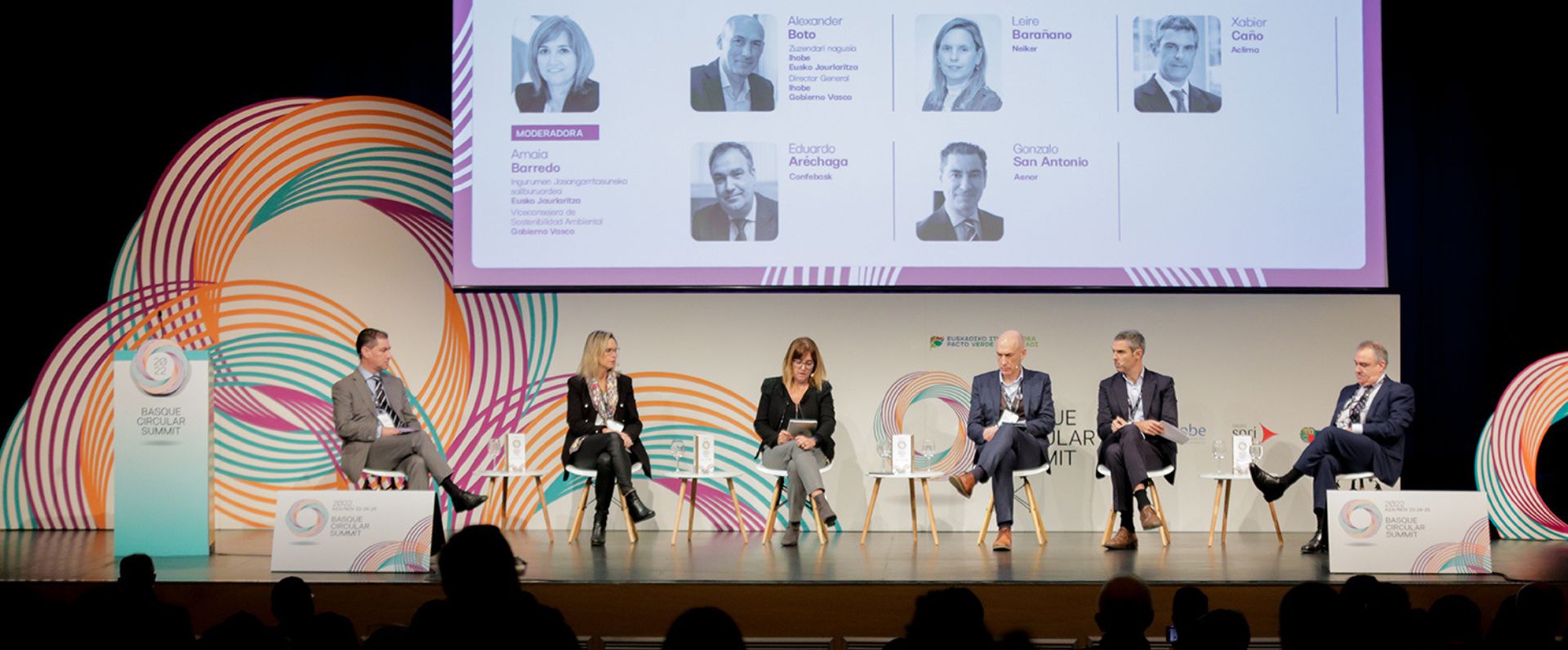
Day two of the Basque Circular Summit focuses on Basque SMEs and explains the different challenges and opportunities posed by the circular economy in each sector to them
Ihobes General Manager pointed to instruments such as the Circular SME Programme, by means of which the Basque Government would like to facilitate the transition process towards a circular model for Basque SMEs with tools and economic support to improve their competitiveness.Meanwhile, the Basque Government's Deputy Minister for Environmental Sustainability, Amaia Barredo, reminded us that "The Basque Country has been working for around 20 years in the field of circular economy, and is now one of the leading regions in this field". She backed this statement up with data: the circular economy accounts for 1.12% of the regions GDP today, with an annual gross revenue of 764 million euros. In terms of employment, jobs related to the circular economy represent 2.08% of total employment in the Basque Country. This is higher than in Spain and Germany, with 2% and 1.71% respectively.
A day focusing on SMEs
Yesterday, the Basque Circular Summit introduced the major issues that are being raised in Europe, such as the digital product passport, the search for less dependence on raw materials, sustainable finance and new eco-design regulations. Alejandro Villanueva, Deputy Head of Circular Economy and Industrial Leadership at the Joint Research Centre (JRC) of the European Commission, noted that eco-design combined with an energy label is the instrument that has worked best to motivate manufacturing companies to design better products and consumers to make better choices: energy equivalent to the consumption of Italy in 2020 has been saved in Europe. There will soon also be a proposal for a directive on green labels, as there are more than 200 different labels in Europe and 40-50% of them are considered to be greenwashing.Jorge Fernández, coordinator of the Environment & Energy Lab at Orkestra-Basque Institute of Competitiveness, said today that the challenges for the value chain revolve around transparency and market positioning, eco-designs for a circular economy, secondary raw materials and waste management, decarbonisation with a life-cycle approach, zero pollution and sustainable finance. Day two will look at how these challenges will affect each sector of Basque industry, through eleven thematic round tables with the participation of more than 70 companies and presentations on the good practices of SMEs.
Antonio Novo Guerrero, Chairman of the European Cluster Alliance, opened the sessions by talking about the importance of involving the entire value chain by getting the various agents involved to work together: It has proven to be fundamental to the circular economy. And in my opinion, the Basque cluster system is one of the most mature in Europe. Luis Lehmann, a specialist in circular economy solutions, stated that the way out of the successive crises is to promote a paradigm shift with new models. And we need to bear one thing in mind: the circular economy is first and foremost an economy. And it needs to provide benefits by promoting development by decoupling the utilisation of resources.
Real examples of circularity in the Basque Country
The Circulares/Zirkularrak (Circular Products) exhibition will be open until November 27 at Ficoba, and includes 175 eco-designed products from 115 Basque companies
A toothpaste in tablet form, a shopping trolley made from advertising hoardings or a cheese sauce made from an ingredient that would otherwise go to waste are some of the examples in the Circulares/Zirkularrak (Circular Products) travelling exhibition. It includes 175 sustainable products from 115 companies in the Basque Country from various industrial sectors and proposes a comprehensive vision of the potential of eco-design and the circular economy in all areas of Basque business activity: the automotive sector, machinery, metal, mobility, the chemical sector, food, furniture, consumer products, construction materials and the electrical and electronics sector.These are products that have substantially reduced their environmental impact by following eco-design methodologies and a life cycle approach. These include a floating solar photovoltaic structure made by Emica Solar which provides the advantages of solar photovoltaic generation, in addition to providing significant improvements due to the fact that it is floating such as zero ground occupation and better cooling.
There is a product from the Azti technology centre that focuses on using food waste: this is a sauce with the aroma of mature cheese, produced from the whey resulting from making Idiazabal cheese, which would otherwise go to waste. One of the products consumer on show is a toothpaste in tablet form. This is a completely new system developed by Onak which, as it is in tablet form, reduces water consumption by 70% and uses refillable and fully reusable containers. There is also a shopping trolley made of advertising hoardings by Sindesperdicio. Another example, this one from the machinery sector, is the NX PRO dual filament-pellet 3D printer manufactured by Indart 3D. It can work with 100% recycled material and the printed parts can be fed back into the printer. These are just some of the 175 exhibits on show that can be visited at Ficoba free of charge until November 27.
European Week for Waste Reduction
On this second day of the Basque Circular Summit, the Basque candidates for the European Week for Waste Reduction 2022 (EWWR) will also be presented. It is an initiative that encourages all European citizens to take action to raise awareness about managing resources and waste sustainably. There have been almost 120 actions submitted this year in the Basque Country, figures that put the region at the top of the European rankings in terms of the ratio of actions submitted per 100,000 inhabitants, Regional Deputy Minister Barredo pointed out.The four entities selected were: the exhibition Sustainable waste: fiction or reality?, promoted by Bergara Town Council; a 'vintage' event in Bilbao to give clothes a second life, promoted by Espacio Open; a new proposal to consume fashion responsibly based on interchangeable patches, by the Sopelana-based clothing brand NEUK; and a project to soundproof the canteen at St. George's British International School in Leioa by making acoustic panels with old towels and recycled pieces of cloth.
Iturria:Ihobe