



- Korporatibo
- Ingurumen-komunikazioa
José Antonio Armolea: "Talking to the Administration makes it easier for companies to comply with environmental legislation"
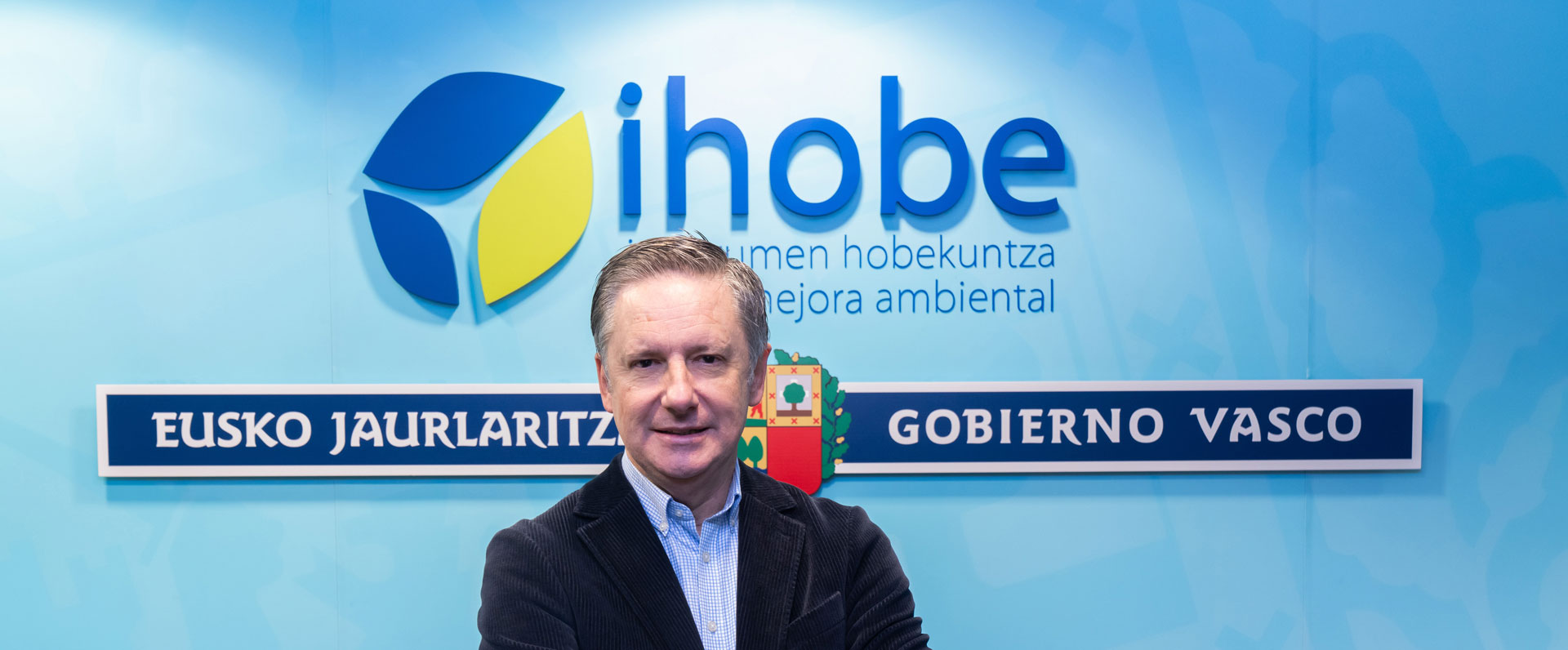
Few people have as much experience in environmental legislation in the Basque Country as José Antonio Armolea Solabarrieta, a lawyer at Ihobe. Apart from the normal course of his work, he has spent several years on his PhD dissertation entitled 'The Legal System for Integrated Pollution Prevention and Control', where he offers guidelines on how to foster agreements between companies and Administration that are always useful and beneficial to abide by the legislation. His work was awarded the Pedrol i Rius Prize to the best PhD dissertation in local law.
QUESTION. How would you explain what your prize-winning PhD dissertation is about to a non-specialist audience?
ANSWER. The dissertation is on integrated pollution prevention and control legislation, considered to be the most demanding that exists for economic activities, including the industries that have a great impact on air, water and soil. We are talking about around 300 activities in the Basque Country, known in the European Union as IPPC.
Q. Potentially polluting, is that right?
A. That's right. My idea was to look at the way we could, from the law, facilitate compliance of some of those obligations. Because one of the problems that activities often face is that as the regulations are very strict they may not tend to meet them or to meet them on a longer timeline. I started from an idea that we already have in place in the Basque Government and Ihobe: several years ago, we rolled out a series of voluntary agreements with IPPC companies to facilitate compliance of those requirements.
Q. What are you referring to when you speak about 'voluntary environmental stewardship instruments'?
A. I studied which voluntary instruments exist in the legislation that could be used. I analysed three types of instruments: EMAS, which is the European voluntary environmental management system for companies; the European eco-labelling system; and the environmental agreements between economic operators and the Administration. I chose two out of those three, because I did not see that potential the label had for the dissertation. As regards the agreements, I had to first identify which issues are likely to be agreed. And then, pinpoint the parts of the law where an agreement could be reached and for legal certainty to exist. I also looked at what happens in other autonomous communities, in other countries... That could also be done with other legislation.
'The aim is to create a relationship of trust between the company and the Administration'
Q. An idea for future dissertations How long did it take you?
A. Quite long. It is true that I began with great enthusiasm, but then everyday life, family, work... It has been years, but there were some when I did not write anything. It was a huge burden and I was about to give up. In the end, my family encouraged me to keep on and I really got down to it in the last year. I handed it in just a few days before the end of the extension.
Q. Why would you recommend companies to use those instruments?
A. In reality, companies and authorities use these instruments in the normal course of our work. In other words, where there is an environmental requirement to be met companies talk to the Administration and sometimes reach agreements, when possible and there is room to do so in the legislation. Talking to the Administration facilitates things for companies. It does not only demand licences and authorisations from them and issues fines; it also listens to them and provides channels to comply with the legislation. What I say is: if we are already doing it, let us do it with legal rigour. That is positive for companies. However, it is not a relationship on equal terms, because the Administration is always the guarantor that the law is met. A level of trust should not be confused with anything goes. But the fact of listening to the company and that the company feels that its problems, its difficulties are being heard, is very useful for companies and for the Administration alike. And passing laws that nobody obeys is pointless.
Q. And does the Administration have room to be flexible?
A. Of course, and that flexibility has to be found. Depending on the circumstances, the legislation can allow for adaptation periods for compliance. When you find a margin of discretion, you have to use it, but in a legally and technically controlled way.
Q. Does this voluntary way lead to a saving of costs and effort?
A. Perhaps in terms of time. If the legislation allows that a corrective measure can be done in four instead of one year, that gives the company room. Some control or administrative formality can be saved. The aim is to create a relationship of trust between the company and the Administration. If I trust you, you can benefit in terms of certain time lines, etc. We have a specific case in Basque legislation as regards construction and demolition waste. Companies have to provide a bond to guarantee that they are going to manage the waste correctly; if they fail to, the local council will implement the bond. The legislation does not require the bond from EMAS companies because the Administration understands that they will do things correctly as they are in an environmental management system. That means cost savings for the company and a smoother relationship.
'We are a benchmark in Europe because we have already strived to introduce administrative benefits in our legislation to encourage organisations to improve environmentally'
Q. How is that relationship of trust created? It will not be easy at first.
A. Of course, it has to be built. First, you need to gather information and learn about the legislation. Awareness must be raised. We work with associations, such as Aclima, and we must be proactive to get companies to sign up, above all, to the EMAS system. The result in the Basque Country is good if we compare ourselves with other Autonomous Communities and European Union States. We have 200 organisations in EMAS, more than countries such as France, Belgium, the Netherlands
Q. Proportionally or in absolute numbers?
A. In absolute numbers, the Basque Country has more than other countries as there is less take up in those of the EMAS system; it is at European level and stands out because the Administration intervenes and it guarantees a transparency that ISO 14001 does not provide. An organisation is awarded this certificate because it complies with the law. It is a transparent system; we are working hard for companies to believe in that system, because it is a way for environmental improvement. Accordingly, we are a benchmark in Europe because we have already strived to introduce administrative benefits in our legislation to encourage organisations to improve environmentally. In the Basque Country we talk to the companies a great deal. There is room for improvement, we have many meeting points.
Q. What is the greatest driver to comply with environmental legislation: fear of possible fines or real environmental awareness?
A. Notwithstanding fines being issued, when necessary, competitiveness is what drives companies the most. Anyone not on the path of sustainability, the circular economy or the energy transition, is being left behind. There is also great awareness among citizens.
.jpg)
Q. Where are the many obstacles to reach those agreements between both parties?
A. Companies complain, and rightly, of the amount of legislation and red tape. The Government is now preparing a law to cut red tape. And in the Basque Country, we approved the Environmental Administration Act in 2021, where one of the fundamental goals is to reduce and streamline administrative formalities. And I believe that we have taken very important steps. We have unified the administrative procedures. Now, all the authorisation and all requirements can be managed with a single authorisation, involving just one procedure, for all activities with environmental impact in the Basque Country.
Q. Where is the greatest room for improvement at the moment?
A. There clearly is. European legislation requires high quality standards. And in the Basque Country as well. One example would be the contaminated soil legislation in this Autonomous Community. We are very demanding environmentally speaking, and we will continue to be so. There is room for improvement as regards the formalities. It is essential to simplify the administrative procedures without lowering those quality standards.
Q. And to end, what role does Ihobe play in this area?
A. It has a strong track record as a facilitator. And we do a great deal of work on awareness raising and dissemination. Having information, guides, etc. helps to comply with the legislation. I believe that we are recognised in and outside the Basque Country as an organisation that works with legal and technical rigour.
Iturria:Ihobe